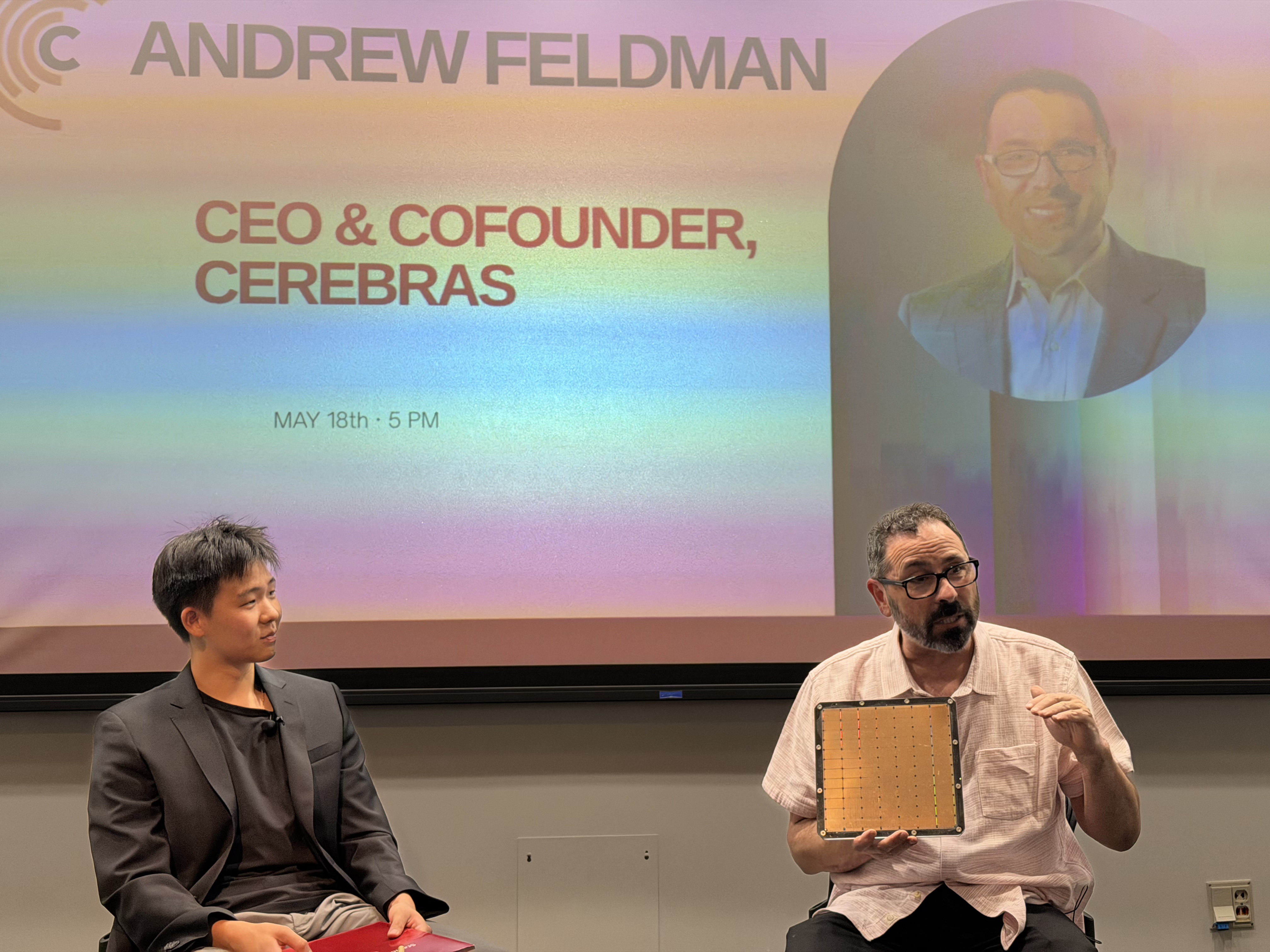
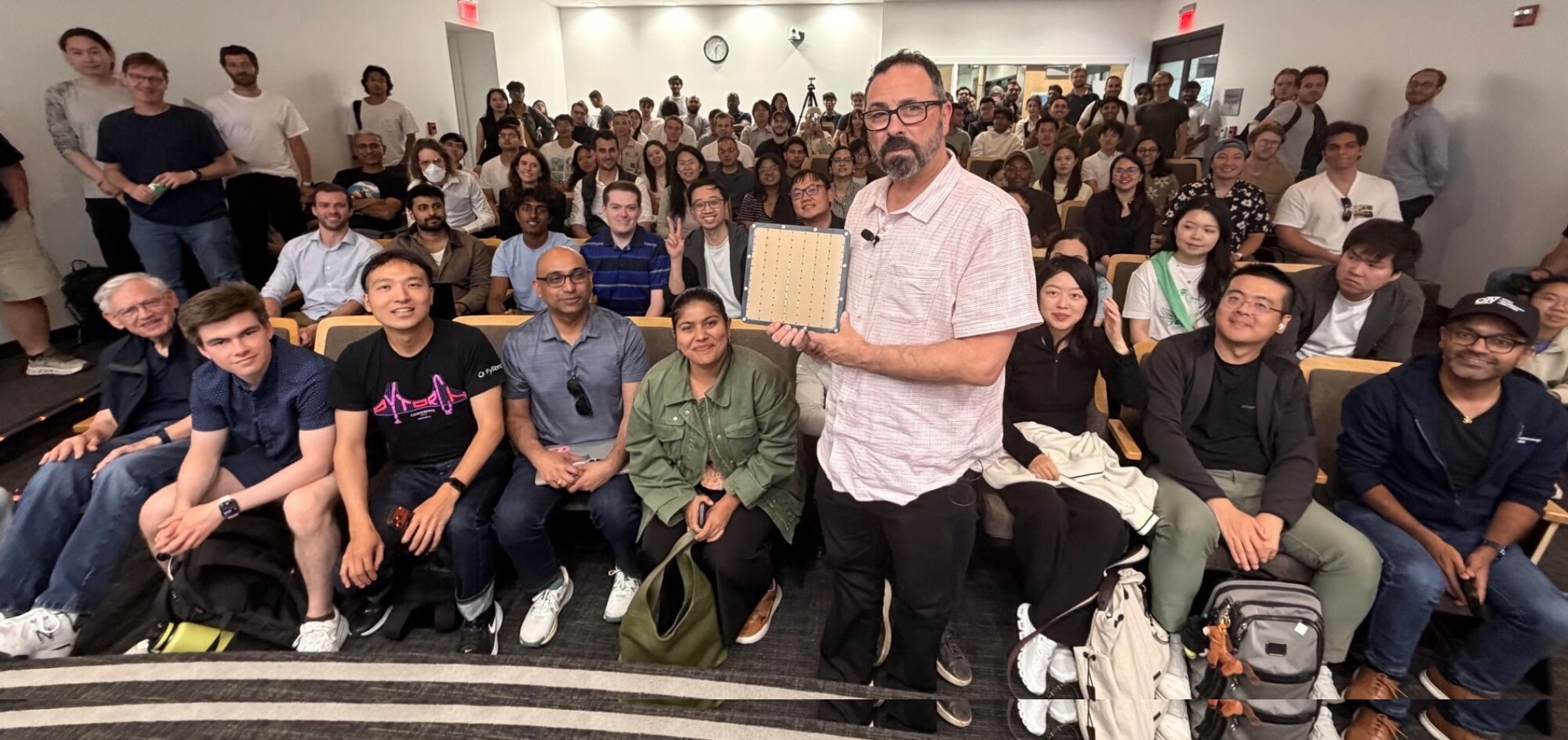
I just attended an event featuring Cerebras CEO Andrew Feldman, where I listened to him share the story behind this dark horse AI chip company that recently completed a mega IPO valued at nearly $100 billion. The biggest question in the industry right now is whether they can truly gain a firm foothold under the monopoly of the tech giants, and from a secondary market perspective, whether this is a core asset worth holding long-term. Combining his on-stage sharing with my follow-up discussions with him alongside other audience members, here are a few of my genuine takeaways.
Breaking the "Memory Wall"
To understand this company, we have to go back to their early days.
The Status Quo: When they started in 2016, the entire industry was focused on standard horizontal clustering of small chips. At the time, some startups chose a relatively safe route: manufacturing normal-sized chips filled entirely with SRAM.
The Latency Cost: This approach was less error-prone technically, but the cost was steep: to hold a large model, you have to tile and connect thousands of chips, and the moment data transfers across chips, the speed drops exponentially—running about 10,000 times slower.
The Wafer-Scale Bet: From the very beginning, Andrew's team refused to make marginal 8% improvements in a lane carved out by others. They bet on an incredibly difficult path—building a giant chip that takes up the largest square you can cut out of an entire 300-millimeter wafer. By tightly integrating massive amounts of memory and compute cores on the same giant silicon wafer, they completely contained data communication within the chip.
Overcoming Yield: At the time, the entire industry thought it was impossible because if even a single physical flaw appeared on the wafer, the whole chip would be ruined. To overcome this yield trap, they managed to figure out a redundancy design borrowed from the memory industry, utilizing redundant identical tiles so the system can naturally withstand flaws.
The Culture of Grit
What sustained them through those darkest hours was a fundamental character trait ingrained in the team's bones. When discussing hiring and team culture, Andrew specifically emphasized grit and determination.
- He shared an interesting story regarding a famous Stanford University study tracking geniuses.
- The study recruited a large group of kids with unbelievably high scores on IQ tests, but ultimately, not a single one of those super-geniuses won a Nobel Prize.
- Conversely, two individuals who were initially rejected from the program for failing to meet the IQ test threshold later became Nobel laureates.
- He used this to illustrate that once you cross the baseline of being smart, what truly accounts for the ceiling of your achievements is persistence and grit.
Future Technical Conflicts
During the Q&A, I asked him about some future technical conflicts.
Software Ecosystem: Facing NVIDIA's CUDA and Google TPU's JAX and XLA ecosystems, will Cerebras's own software stack become a shortcoming? His answer was very direct: this is not a question of whether the technology can be built, it's simply a matter of time. Rebuilding the software ecosystem relies on continuous time and capital investment, which they have clear expectations for and are willing to wait out.
End-to-End Efficiency: Right now, their inference speed is blazingly fast, but in actual business operations, a massive amount of prerequisite tasks and scheduling runs on the CPU. How do they solve this? His answer showed extreme restraint: leave the CPU problems to the companies that make CPUs. Their strategy is highly focused—putting all their energy into a single breakthrough point to push inference to the absolute limit.
The TSMC Supply Chain
Audience members also raised the widely-held concern about the supply chain: given the massive scale of current tech giants, why would TSMC allocate capacity to Cerebras?
Ecosystem Balance: Andrew revealed that TSMC's long-term strategy is to maintain the balance of its customer ecosystem and prevent being completely hijacked by one or two giants.
Historical Precedents: He cited real historical examples: when Apple first decided to step in and make its own chips, and when AWS acquired an Israeli startup to start building chips, they both started as very small customers. TSMC knows full well that disruptive innovation often comes from these early game-changers.
Capacity Allocation: Consciously reserving capacity for high-growth innovative companies is TSMC's strategy for checks and balances. Last year, Cerebras wasn't even in the top 150 of TSMC's customers, but this year they will be a top 15 customer, and next year top 8. As long as there is real growth, capacity is not an insurmountable obstacle.
Conclusion and a "Fun Fact"
Overall, on whether this company is a worthwhile long-term hold: they are not an opportunistic startup, but trailblazers with a pragmatic engineering culture, extremely high barriers to entry, and a resilient character flowing in their veins. If you believe in the logic of fundamentally restructuring hardware and are willing to give its software stack a period to mature, this is an asset with very solid fundamentals that is absolutely worth holding long-term.
Finally, I'll share an interesting story:
When the moderator asked how the company plans to deploy the $5.5 billion in fresh cash they just raised from the IPO, Andrew didn't immediately paint a blueprint for expanding production. Instead, he mentioned an anecdote—the sum of money was so large that Morgan Stanley couldn't even wire it all at once because their single wire limit is $5 billion, forcing them to send it in two separate wires. Facing this astronomical amount of funds, Andrew recalled with considerable emotion, "We didn't start out that way". He remembered the long years from 2017 to 2019 when they couldn't solve their technical problems, burning through $8 million a month and having to bite the bullet every six weeks at board meetings to tell investors, "Yeah, we're continuing to destroy your money". Contrasting that with today's nearly $100 billion market cap, this is perhaps the most authentic and awe-inspiring portrayal of hardcore tech entrepreneurship.
刚参加了一场Cerebras CEO Andrew Feldman参与的活动,听他分享了这家刚完成千亿美元级别IPO的AI芯片黑马背后的故事。行业里现在最关心的,无非是他们能否在巨头垄断下真正站稳脚跟,以及从二级市场的视角来看,这到底是不是一个值得长期持有的核心资产。结合他在台上的分享,以及后续我和现场观众与他的交流,梳理几点真实的感受。
要看懂这家公司,必须回到他们早期的经历。2016 年创办时,整个行业都在做小芯片横向拼接。当时有些初创公司(比如 Groq)选择了一条相对稳妥的路线,即制造正常尺寸的芯片并铺满 SRAM。这种做法在技术上不容易出错,但代价是:要承载一个大模型,必须平铺并连接几千颗芯片,数据一旦跨芯片传输,速度就会呈指数级下降。
但 Andrew 的团队从一开始就不愿在别人划好的赛道里做边际改进。他们押注了一条极其艰难的路——直接做占据一整块晶圆大小的芯片。通过把海量内存和计算核心紧密集成在同一块大硅片上,彻底把数据通信留在芯片内部解决,打破了制约算力的内存墙。当时全行业都认为这不可能,因为只要晶圆上出现一处物理瑕疵,整块芯片就会报废。为了跨越良率死局,他们熬过了极其痛苦的阶段,硬是摸索出了来自存储器行业的冗余设计,让系统能够天然耐受缺陷。
能够支撑他们走过那段至暗时刻的,是团队骨子里的一种性格底色。在聊到招人和团队文化时,Andrew特别强调了毅力Grit和决心。他讲了一个很有意思的故事:斯坦福大学曾经做过一个著名的天才追踪研究,招募了一大批智商极高的孩子,但最终这些超级天才中没有一个人拿到诺贝尔奖;相反,有两个当初因为智商测试不达标而被该项目拒之门外的人,后来却成了诺贝尔奖得主。他借此说明,在跨过聪明的及格线之后,真正决定成就上限的是坚持和韧性。
在交流环节,我问了他一些关于未来的技术冲突。首先是软件生态:面对英伟达的CUDA,以及Google TPU的JAX和XLA生态,Cerebras自己的软件栈会不会成为一个短板?他的回答很直接:这不是技术能不能实现的问题,单纯是一个时间问题。在底层硬件具备物理级优势的前提下,重构软件生态靠的是持续的时间和资金投入,他们对此有清晰的预期并愿意等待。
顺着这个思路,我又追问了关于端到端效率的问题。现在他们的 inference 速度极快,但在实际业务中,大量的前置任务和调度是在CPU上跑的。既然CPU 拖慢了整体效率,系统层面怎么解决?他给出的答案展现了极度的克制:CPU的问题交由做CPU的公司去解决,Cerebras 绝对不会越界去做CPU和inference之间的联合优化。他们的战略非常聚焦,就是把精力全部放在单点突破上,把 inference 做到极致。
现场也有观众提出了大家普遍担心的供应链问题:在当前巨头的体量下,台积电凭什么给 Cerebras产能?Andrew揭示了代工巨头的生存逻辑:台积电的长期战略是维持客户生态的平衡,防止被一两家巨头彻底绑架。他举了历史上真实的例子:早年苹果决定自己下场做芯片时,以及亚马逊 AWS 收购以色列初创公司开始造芯片时,最初也是从体量很小的客户做起的。台积电深知行业的颠覆性创新往往来自这些早期的破局者。绝对不希望自己的产能仅仅依赖于苹果和英伟达,有意识地向高增长的创新公司预留产能,是台积电的制衡术。Cerebras去年还排不上台积电客户的前 150 名,今年已经杀进前 15。只要有真实的增长,产能并不是不可逾越的障碍。
综合来看,关于这家公司是否值得长期持有:他们不是一家投机的初创企业,而是骨子里流淌着务实工程文化、极高壁垒和坚韧性格的开拓者。如果你相信底层硬件重构的逻辑,并愿意给它的软件栈一段发育期,这是一个基本面非常扎实、值得长期持有的标的。
最后分享一个有趣的故事:当主持人问到,公司刚通过IPO获得了55亿美元的新鲜现金,打算如何部署这笔钱时,Andrew 并没有直接描绘扩产蓝图,而是提到了一个插曲——这笔钱实在太大,以至于Morgan Stanley无法一次性打款,因为他们单笔电汇的上限是 50 亿美元,最后只能分两笔汇入。面对这样一笔天量资金,Andrew 颇为感慨地回忆道:“我们最初可不是这样的。”他想起了 2017 到 2019 年那段无法解决技术难题的漫长岁月,当时他们每个月烧掉 800 万美元,每六周就要硬着头皮去见投资人说:“是的,我们还在继续毁掉你们的钱(destroy your money)。” 对比今天的近千亿市值,这也许就是硬核科技创业最真实、也最震撼的写照。
📬 Stay Updated
Get notified when I publish new posts. No spam, unsubscribe anytime.
Already have an account? sign in to manage subscription.