This translation is not available yet. Showing the original article.
Bridging the Human-AI Speed Divide: Overcoming the Bottlenecks to True Automation
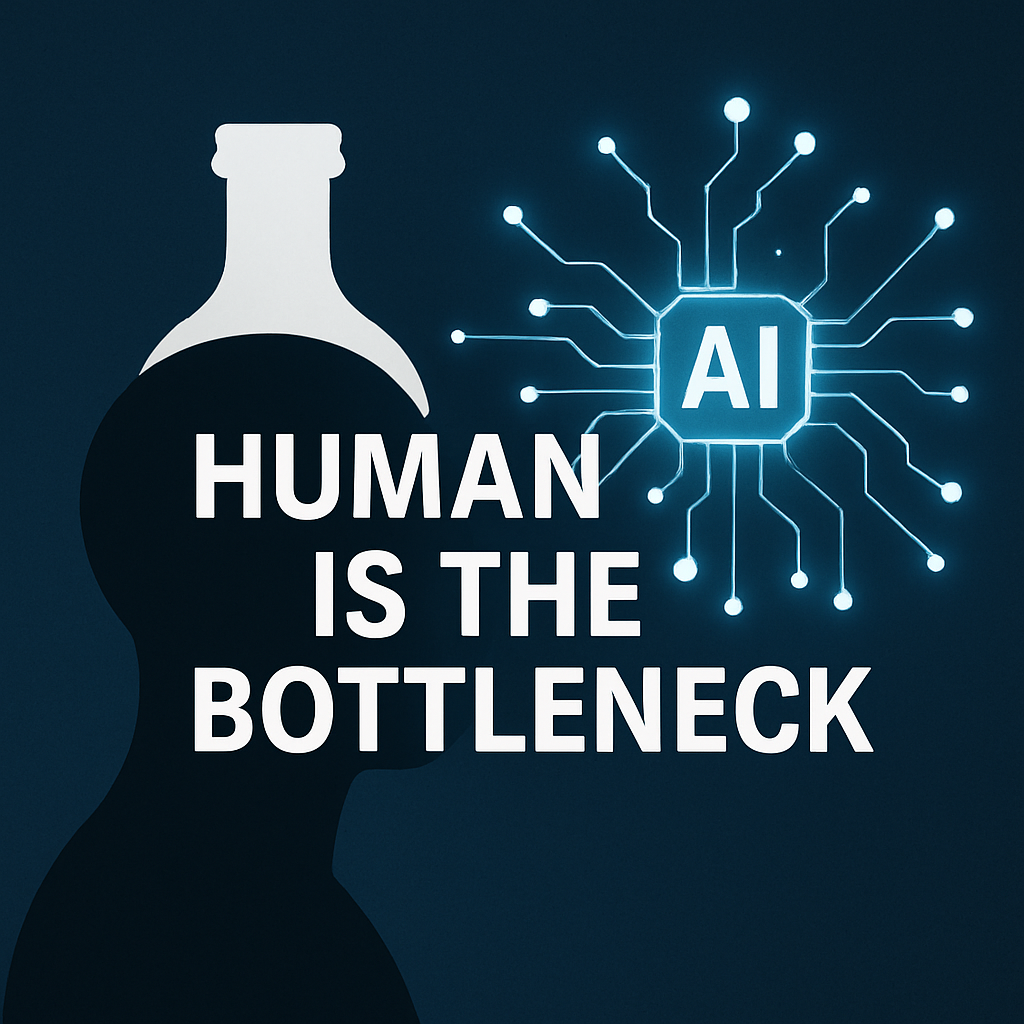
One of the central challenges in the age of AI is the profound speed mismatch between human oversight and artificial intelligence. While an AI can process information and execute tasks at speeds potentially millions of times faster than we can, its progress is often tethered to the much slower pace of human intervention. Because AI systems ultimately serve human goals, they frequently require our approval or input to make decisions. This dynamic creates a significant bottleneck and raises a critical question: How can we adapt to collaborate effectively in the fast-paced world of AI?
If we want to unlock the full potential of AI, we must enable it to operate automatically in seamless, end-to-end workflows. However, in our current setting, two fundamental issues stand in the way.
First, there is the feedback loop problem. An AI often lacks a complete, real-time understanding of its environment. After executing a task, it cannot independently perceive the outcome. It falls to a human operator to bridge this gap by providing this feedback—whether by verifying a result on a website, providing a screenshot, or querying a database. This manual step fundamentally disrupts the AI's speed and hinders true automation.
Second, we face a communication and context gap. AI struggles to grasp the nuances, implicit goals, and unstated assumptions behind our requests. We, in turn, are often unaware of the specific ambiguities or missing information the AI is encountering. This communication disconnect forces the AI into a difficult choice: either guess our intent, which risks errors, or pause the process to ask for human clarification, which defeats the purpose of its speed.
Looking ahead, solving these two core problems is the key to unlocking the next era of productivity. The goal is not for humans to somehow "move as fast as AI," but to design systems where the friction of human intervention is minimized. By creating AI that can independently perceive its environment and more accurately infer human intent, we can enable truly autonomous workflows. This will allow us to scale our collective intelligence and achieve outcomes at a pace previously unimaginable.
Bridging the Human-AI Speed Divide: Overcoming the Bottlenecks to True Automation
One of the central challenges in the age of AI is the profound speed mismatch between human oversight and artificial intelligence. While an AI can process information and execute tasks at speeds potentially millions of times faster than we can, its progress is often tethered to the much slower pace of human intervention. Because AI systems ultimately serve human goals, they frequently require our approval or input to make decisions. This dynamic creates a significant bottleneck and raises a critical question: How can we adapt to collaborate effectively in the fast-paced world of AI?
If we want to unlock the full potential of AI, we must enable it to operate automatically in seamless, end-to-end workflows. However, in our current setting, two fundamental issues stand in the way.
First, there is the feedback loop problem. An AI often lacks a complete, real-time understanding of its environment. After executing a task, it cannot independently perceive the outcome. It falls to a human operator to bridge this gap by providing this feedback—whether by verifying a result on a website, providing a screenshot, or querying a database. This manual step fundamentally disrupts the AI's speed and hinders true automation.
Second, we face a communication and context gap. AI struggles to grasp the nuances, implicit goals, and unstated assumptions behind our requests. We, in turn, are often unaware of the specific ambiguities or missing information the AI is encountering. This communication disconnect forces the AI into a difficult choice: either guess our intent, which risks errors, or pause the process to ask for human clarification, which defeats the purpose of its speed.
Looking ahead, solving these two core problems is the key to unlocking the next era of productivity. The goal is not for humans to somehow "move as fast as AI," but to design systems where the friction of human intervention is minimized. By creating AI that can independently perceive its environment and more accurately infer human intent, we can enable truly autonomous workflows. This will allow us to scale our collective intelligence and achieve outcomes at a pace previously unimaginable.
跨越人类与 AI 的速度鸿沟:突破实现真正自动化的瓶颈
AI 时代的核心挑战之一,是人类监督与人工智能之间巨大的速度差距。AI 处理信息、执行任务的速度可能比我们快数百万倍,但它的进展常常受制于缓慢得多的人类干预。由于 AI 系统最终服务于人类目标,它们在做决策时经常需要我们的批准或输入。这种关系造成了显著的瓶颈,也提出了一个关键问题:我们该如何适应,在高速运转的 AI 世界中有效协作?
如果想释放 AI 的全部潜力,我们就必须让它在无缝衔接的端到端工作流中自动运行。然而,在当前条件下,有两个根本问题阻碍着这一目标。
首先,是反馈回路问题。AI 往往无法完整、实时地了解所处的环境。执行任务后,它不能独立感知结果。弥补这一缺口、提供反馈的责任便落在人类操作者身上,无论是在网站上验证结果、提供截图,还是查询数据库。这一步人工操作从根本上打断了 AI 的速度,也阻碍了真正的自动化。
其次,我们面临着沟通与上下文的鸿沟。AI 很难把握我们请求背后的细微含义、隐含目标和未明说的假设。反过来,我们往往也不清楚 AI 正遇到哪些具体歧义或缺失信息。这种沟通脱节迫使 AI 做出艰难的选择:要么猜测我们的意图,冒着出错的风险;要么暂停流程,请人类澄清,这又抵消了它的速度优势。
展望未来,解决这两个核心问题,是开启下一轮生产力发展的关键。目标并不是让人类设法“和 AI 一样快”,而是设计出尽量减少人类干预摩擦的系统。通过让 AI 独立感知环境,并更准确地推断人类意图,我们就能实现真正自主的工作流。这将使我们得以扩展集体智能,以过去难以想象的速度取得成果。